IMF-World Bank a Pest to the Philippine Society
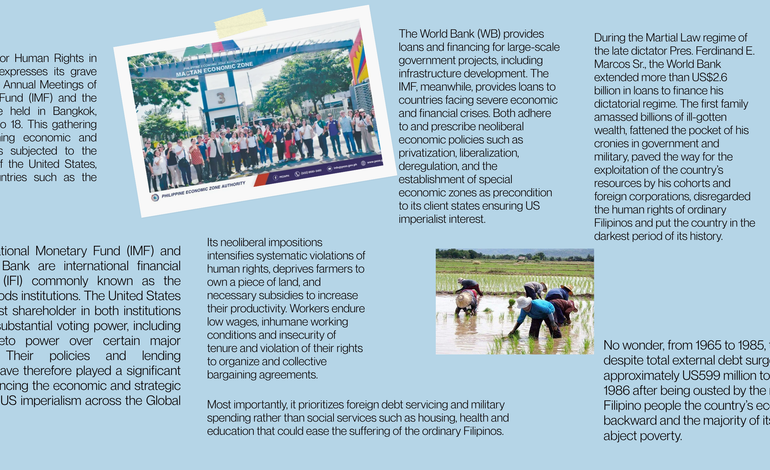
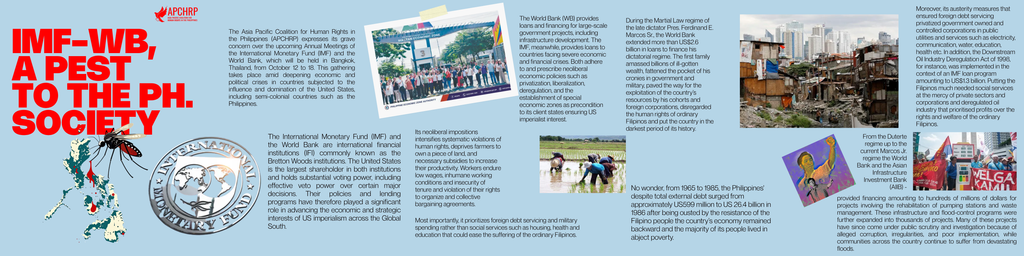
The Asia Pacific Coalition for Human Rights in the Philippines (APCHRP) expresses its grave concern over the upcoming Annual Meetings of the International Monetary Fund (IMF) and the World Bank, which will be held in Bangkok, Thailand, from October 12 to 18. This gathering takes place amid deepening economic and political crises in countries subjected to the influence and domination of the United States, including semi-colonial countries such as the Philippines.
The International Monetary Fund (IMF) and the World Bank are international financial institutions (IFI) commonly known as the Bretton Woods institutions. The United States is the largest shareholder in both institutions and holds substantial voting power, including effective veto power over certain major decisions. Their policies and lending programs have therefore played a significant role in advancing the economic and strategic interests of US imperialism across the Global South.
The World Bank (WB) provides loans and financing for large-scale government projects, including infrastructure development. The IMF, meanwhile, provides loans to countries facing severe economic and financial crises. Both adhere to and prescribe neoliberal economic policies such as privatization, liberalization, deregulation, and the establishment of special economic zones as precondition to its client states ensuring US imperialist interest.
Its neoliberal impositions intensifies systematic violations of human rights, deprives farmers to own a piece of land, and necessary subsidies to increase their productivity. Workers endure low wages, inhumane working conditions and insecurity of tenure and violation of their rights to organize and collective bargaining agreements. Most importantly, it prioritizes foreign debt servicing and military spending rather than social services such as housing, health and education that could ease the suffering of the ordinary Filipinos.
During the Martial Law regime of the late dictator Pres. Ferdinand E. Marcos Sr., the World Bank extended more than US$2.6 billion in loans to finance his dictatorial regime. The first family amassed billions of ill-gotten wealth, fattened the pocket of his cronies in government and military, paved the way for the exploitation of the country’s resources by his cohorts and foreign corporations, disregarded the human rights of ordinary Filipinos and put the country in the darkest period of its history. No wonder, from 1965 to 1985, the Philippines’ despite total external debt surged from approximately US599 million to US 26.4 billion in 1986 after being ousted by the resistance of the Filipino people the country’s economy remained backward and the majority of its people lived in abject poverty.
IMF-World Bank imposition ensuring US imperialist agenda in the country continues in the succeeding regimes. Its neoliberal policies enacted laws, policies and programs that characterized as pro-imperialist, pro-oligarch and anti-people like Masagana 99, Labour Export Program (LEP), Mining Act of 1995, TRAIN Law, CREATE Act, Labour-only Contracting Policy among others depriving ordinary Filipinos of genuine development and their right to live justly and humanely.
Moreover, its austerity measures that ensured foreign debt servicing privatized government owned and controlled corporations in public utilities and services such as electricity, communication, water, education, health etc. In addition, the Downstream Oil Industry Deregulation Act of 1998, for instance, was implemented in the context of an IMF loan program amounting to US$1.3 billion. Putting the Filipinos much needed social services at the mercy of private sectors and corporations and deregulated oil industry that prioritised profits over the rights and welfare of the ordinary Filipinos.
From the Duterte regime up to the current Marcos Jr. regime the World Bank and the Asian Infrastructure Investment Bank (AIIB) provided financing amounting to hundreds of millions of dollars for projects involving the rehabilitation of pumping stations and waste management. These infrastructure and flood-control programs were further expanded into thousands of projects. Many of these projects have since come under public scrutiny and investigation because of alleged corruption, irregularities, and poor implementation, while communities across the country continue to suffer from devastating floods.
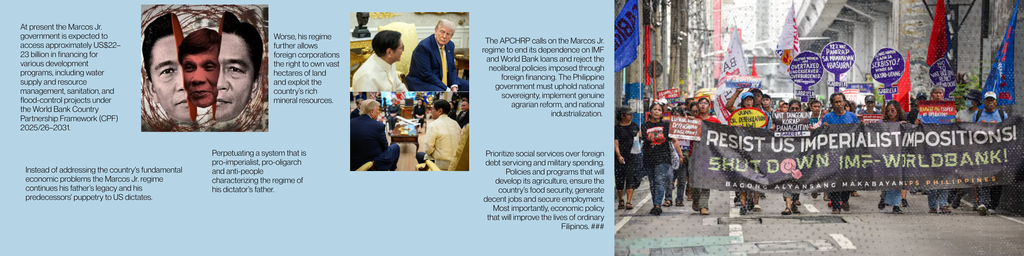
At present the Marcos Jr. government is expected to access approximately US$22–23 billion in financing for various development programs, including water supply and resource management, sanitation, and flood-control projects under the World Bank Country Partnership Framework (CPF) 2025/26–2031. Instead of addressing the country’s fundamental economic problems the Marcos Jr. regime continues his father’s legacy and his predecessors’ puppetry to US dictates. Worse, his regime further allows foreign corporations the right to own vast hectares of land and exploit the country’s rich mineral resources. Perpetuating a system that is pro-imperialist, pro-oligarch and anti-people characterizing the regime of his dictator’s father.
The APCHRP calls on the Marcos Jr. regime to end its dependence on IMF and World Bank loans and reject the neoliberal policies imposed through foreign financing. The Philippine government must uphold national sovereignty, implement genuine agrarian reform, and national industrialization. Prioritize social services over foreign debt servicing and military spending. Policies and programs that will develop its agriculture, ensure the country’s food security, generate decent jobs and secure employment. Most importantly, economic policy that will improve the lives of ordinary Filipinos. ###